
In our modern world, we can control almost everything but the weather. And with modern instruments, satellites, weather balloons, and weather outposts, scientists can predict the weather fairly accurately. But German farmers didn’t have my Channel 6 weather guy with his fancy maps and clickers.
What they DID have were Bauernregeln, or Farmer’s Rules, for predicting the weather.
What are Bauernregeln?
In Germany during the Middle Ages, weather prediction wasn’t scientific, but farmers paid attention to signs around them. Over the years, certain things happening in nature allowed them to predict weather patterns. To remember them and pass them along, they created the rhyming Bauernregeln. There are hundreds of these Bauernregeln- Farmer’s Rules for predicting weather that helped farmers (and others) know when to plant or harvest. To make them easy to remember, they were simple rhymes like-
Kommt die Wilde Ente
hat der Winter ein Ende.
hat der Winter ein Ende.
When the wild ducks arrive,
Winter is over.
Winter is over.
This knowledge was passed down over generations for hundreds of years. Most of the rules concern Winter. When it will end, when it will begin. These days Winter is an inconvenience because of cold and snow, but in the Middle Ages, without the modern conveniences of electricity and running hot water, Winter was harsh. Poor planning meant that people went hungry. Farmers didn’t want to plant too early, because the precious seed would be lost.
Bauernregeln in America
Of all of the hundreds of German Bauernregeln, the one Americans are most familiar with is the rule for Maria Lichtmess.
“Wenn der Igel Lichtmess seinen Schatten sieht,
so kriecht er wieder auf sechs Wochen ins Loch.”
so kriecht er wieder auf sechs Wochen ins Loch.”
“If the hedgehog sees its shadow at Candlemas,
He will crawl back into his hole for another six weeks.”
He will crawl back into his hole for another six weeks.”
Sound familiar? A hedgehog seeing its shadow? When German farmers arrived in Pennsylvania, they brought their rules with them, but forgot to pack the hedgehogs. A local animal had to be substituted. The groundhog slept in a burrow, and, presumably, would cast a shadow if he came out, so it would make a decent substitute. Why THIS rule became a Groundhog Day Festival in Pennsylvania is still a mystery. Possibly because it was more interesting than-
Ist Sankt Gall trocken,
so folgt ein Sommer mit nassen Socken
so folgt ein Sommer mit nassen Socken
If it’s dry on St. Gall’s day (October 16)
The following Summer you will have wet socks.
The following Summer you will have wet socks.
(I hate wet socks, so I’m putting an alert on my calendar for Oct.16)
And it was good to know when to harvest.
Wenn an Johannis die Linde blüht,
ist an Jakobi das Korn reif
If the linden tree blooms on St John’s day (June 24)
Then the grain will be ripe on St James’ day (July 25)
Then the grain will be ripe on St James’ day (July 25)
Saints’ Days act as a Calendar
You will notice that the rules often mention Saints. That’s simply because farmers didn’t have calendars hung on the refrigerator the way we do. Their calendar year was ruled by the church calendar. Even today, New Year’s Eve is called Silvester, since it falls on his day.
More importantly, for the farmers and kitchen gardeners, are the Eisheiligen. These Saints in May relate to the last fears of overnight frost.
“Vor Bonifaz kein Sommer, nach Sophie kein Frost”
Before Boniface no summer, after Sophie no frost
There are rules about rain, rules to know how cold winter will be, and rules about spiders-
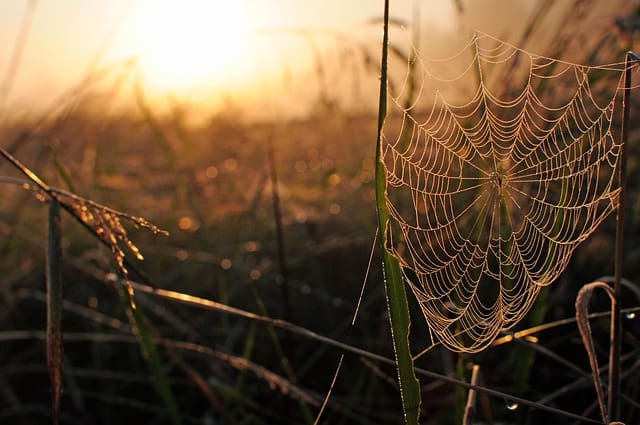
Im Frühjahr Spinweben auf dem Feld,
gibt einen schwülen Sommer.
When there are spider webs on the field in spring,
it will be a humid summer.
A rule that may be familiar to you, because it’s so similar to April Showers bring May Flowers…
Aprilflöckleinbringen Maiglöcklein
April snowflakes bring May lilies of the valley
Or this, one of the oldest of the Bauernregeln-
Abendrot Gutwetterbot’
Morgenrot mit Regen droht.
Morgenrot mit Regen droht.
Red sky at night means good weather
A red sky in the morning signals rain.
A red sky in the morning signals rain.
Bauernregeln Accuracy
By the Age of Enlightenment, scientists brushed off the old rules as being inaccurate. That they were wrong more often than right, and a new scientific understanding of weather phenomena was far superior to watching ducks or spiders. But one important thing to note about the Bauernregeln is that they don’t apply universally. A rule for Swabia can’t be applied in Hamburg. This means that unless you know where the rule came from, it’s worthless. As someone who lives in California, I understand the impossibility of a Pennsylvania Groundhog predicting our weather. However, scientists and historians examined statistics and discovered that, when applied to the right region, the rules are pretty spot-on. You just have to know where the rule started.
Bauernregeln Today
These days, farmers and gardeners may consult satellite data for their Weather prediction, but the old rules are still remembered. My Oma swore by the Eisheiligen, and children still sing about April showers. Who knows, maybe instead of Doppler Radar and computer models, Dave the weatherman on Channel 6 could try using this one for February, it could be fun!
Sonnt sich die Katze im Februar im Frei’n,
muß sie im Märzen zum Ofen hinein.
muß sie im Märzen zum Ofen hinein.
When the cat suns itself outside in February,
she’ll have to warm herself by the oven in March.
she’ll have to warm herself by the oven in March.
Looking for more? You’ll find books about Bauernregeln- Farmer’s Rules for Predicting Weather here-

You could also predict weather like my Oma did, with a weather house!
Trenkle German Black Forest Weather House

References-
“Wenn die Schwalben niedrig fliegen… Bauernregeln” Falken Verlag.
