
Friedrich, the Kaiser great,
Within the castle-cavern
Sits in an enchanted state.”

Who was Friedrich Barbarossa?
Friedrich, son of the Duke of Swabia, became King of Germany in 1152. He took the name Fredrich I when Pope Adrian IV crowned him Holy Roman Emperor on June 18, 1155. I just love this wonderful description of him from “Stories from German History” by Florence Aston, so I will share it in full: “Fredrick’s manner and appearance were such as to inspire confidence. He was of medium height but very strongly built, and his short fair hair waved over a broad forehead and steady, intelligent blue eyes. The mouth was beautifully curved and gave to his face an expression of cheerfulness and gentle kindness. The reddish tinge of his beard gained for him the surname of Barbarossa or red beard.”
(I swear, it sounds like Florence has a serious crush on the guy. And yes, she calls him Fredrick.)
But then, tragedy.
Like other influential rulers, he joined the Third Crusade in 1190, but he drowned in the Saleph River of northwestern Syria before arriving in the Holy Land. There are different stories about his death. Did he have a heart attack while cooling off in the river? Did he get impatient waiting to cross the bridge and attempt to ford the river on horseback, only to get thrown off his horse or swept away? (Armor isn’t very buoyant.) The story goes on that his men discovered his body downstream, dead. His devastated son Friedrich IV, Duke of Swabia (not yet HRE) then preserved the body by pickling it and took it along to be buried in the Holy Land. But they didn’t do a great job with the preservation, so the great Barbarossa fell apart, and parts were buried in a few places across modern Turkey and Lebanon.
A Legend Is Born
But dying that way, by drowning and not in glorious battle, and then being buried without fanfare or monument (not to mention, in pieces) seems to have left room for the birth of a legend. That maybe, the King wasn’t really dead. (Almost like Elvis.)
By the Middle Ages, legends of Barbarossa’s return began to circulate. People believed he could come back to punish the corrupt Church officials. Then came Martin Luther and the Protestant Reformation. Some even believed Barbarossa made it possible for Luther to translate the Bible! But then, the Barbarossa legends died away for a while.
Until the Romantics and dreams of national unity in the early 1800s brought it all back.
The Brothers Grimm, collectors of the famous Fairy Tales, also collected Legends and Sagas. And they included the Legend of Frederick Barbarossa (Saga number 23)
The Legend goes something like this-
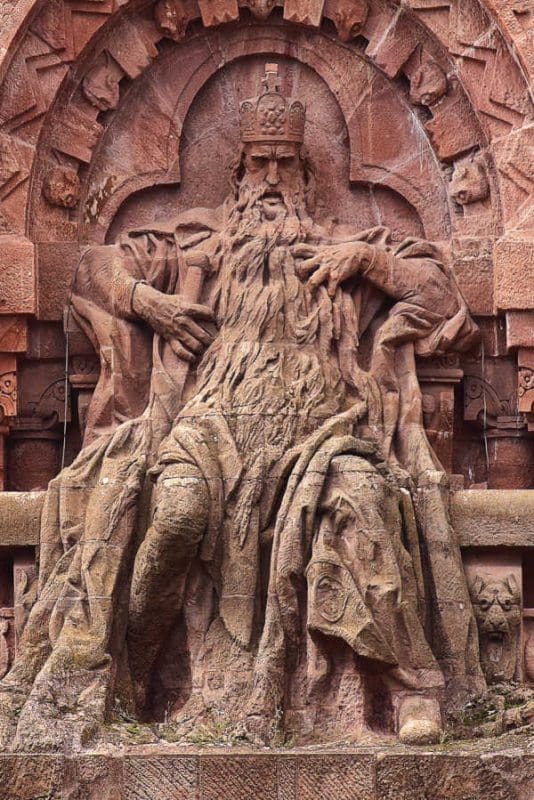
Deep under the Kyffhausen Mountain, Kaiser Barbarossa sleeps on his throne before a stone table, his beard growing longer and longer, wrapping itself around (or through) the table. He sleeps and waits.
Above the mountain, ravens circle. One day, an eagle will chase the ravens away, and Barbarossa will rise to bring back the Golden Age of Germany.
Other versions say that once his beard has circled the table three times, he will awake.
From The Project Gutenberg eBook of “Deutsche SagenFriedrich Rothbart auf dem Kyfhäuser“.
King Under the Mountain
The story of a King under the Mountain isn’t new. In fact, famous American folklorist Stith Thompson put that very motif in his Index of Folklore: A 571- “Cultural Hero Asleep in Mountain”. (You’ll find King Arthur and Genghis Khan there, too.) What strikes me about this legend is how short it is. And that it is number 23 of over 350 legends in the book! I think I expected such an important story to be number 1, and take pages… But maybe that’s how it became so important. Such a short story left a lot of room for interpretation.
.jpg) Hermann Wislicenus (1825-1899).James Steakley at de.wikipedia, Public domain, via Wikimedia Commons
Hermann Wislicenus (1825-1899).James Steakley at de.wikipedia, Public domain, via Wikimedia CommonsPoem to Barbarossa
Barbarossa
Der alte Barbarossa,
Der Kaiser Friedrich,
Im unterird’schen Schlosse
Hält er verzaubert sich.
Er ist niemals gestorben,
Er lebt darin noch jetzt;
Er hat im Schloß verborgen
Zum Schlaf sich hingesetzt.
Des Reiches Herrlichkeit,
Und wird einst wiederkommen
Mit ihr, zu seiner Zeit.
Darauf der Kaiser sitzt;
Der Tisch ist marmelsteinern,
Worauf sein Haupt er stützt.
Er ist von Feuersglut,
Ist durch den Tisch gewachsen,
Worauf sein Kinn ausruht.
Sein Aug’ halb offen zwinkt;
Und je nach langem Raume
Er einem Knaben winkt.
Geh hin vors Schloß, o Zwerg,
Und sieh, ob noch die Raben
Herfliegen um den Berg.
Noch fliegen immerdar,
So muß ich auch noch schlafen
Verzaubert hundert Jahr.
Friedrich, the Kaiser great,
Within the castle-cavern
Sits in an enchanted state.He did not die, but ever
Waits in the chamber deep,
Where hidden under the castle
He sat himself to sleep.
And back to earth will bring it
When dawns the promised day.
Whereof he makes his bed;
The table is of marble
Whereon he props his head.His beard, not flax, but burning
With fierce and fiery glow,
Right through the marble table
Beneath his chair does grow.
He nods in dreams and winketh
With dull, half-open eyes,
And once a page boy he beckons–
A page boy that standeth by.
He bids the boy in slumber
“O dwarf, go up this hour,
And see if still the ravens
Are flying round the tower;
And if the ancient ravens
Still wheel above us here,
Then must I sleep enchanted
For many a hundred year.”
Romantic Movement
These works were important to the Romantic Movement. Why? Shared stories give people a sense of community and a sense of belonging to something greater. When the Grimm Brothers published their volumes of myth in 1815, Germany was just emerging from the French Occupation. Many Germans were disappointed that Germany didn’t come together after the occupation. Instead of a unified Germany, they had a splintered group of 39 States with no clear center. Romantics hoped that instead of identifying as Bavarians or Prussians, German speaking people would see themselves as German first. Art and literature reflected the movement. The Grimm Brothers even published a comprehensive German dictionary. This MASSIVE undertaking that took years and is made up of 32 volumes, all to unify the language.
The Splendor of the Empire
After the unification of 1871, Rucker’s poem became part of the German school curriculum (ask your Opa, he may still remember all the words.)
Read this again-
He took with him away
And back to earth will bring it
when dawns the promised day”
That’s the stanza that everyone remembers.
The King Under the Mountain- Kyffhäusser Monument

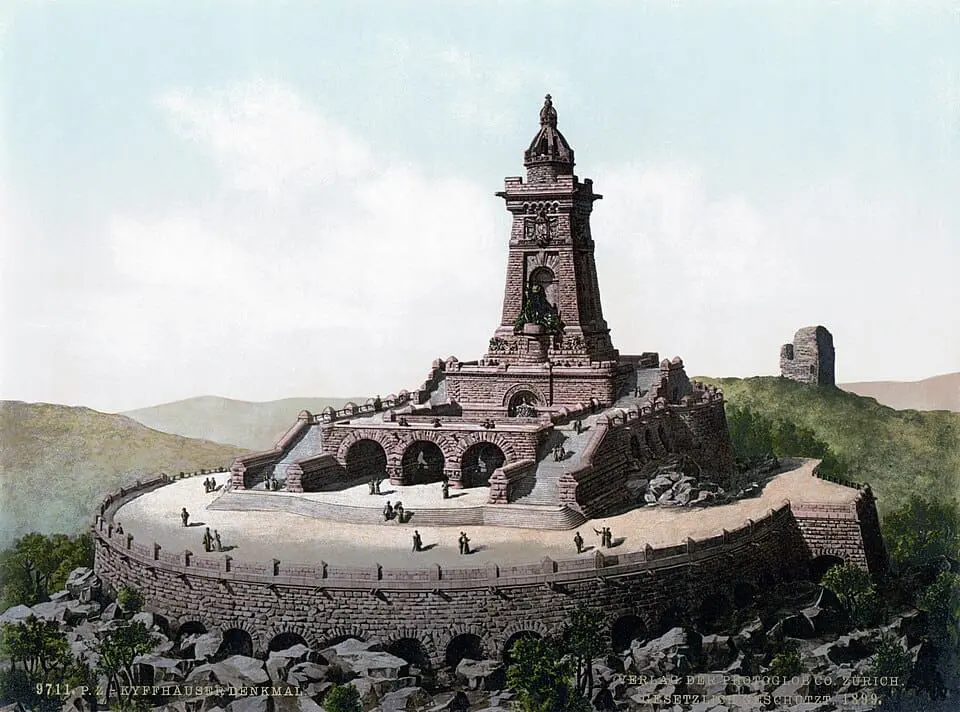
Today, you can visit the Barbarossa Monument on the Kyffhäusser Mountain. It’s MASSIVE. And I’m sure they keep a few ravens on hand to keep things interesting. See it here- Kyffhäusser Monument
Near the monument is the Barbarossa Cave, where I understand you can SEE the king at his stone table, beard wound around its legs (you might have to squint and look from a certain angle). This show cave is open to the public. Find out more here- Barbarossa Cave
References
