
The Gäubodenmuseum is an absolute treasure trove of early German, Celtic, Roman, and Bavarian artifacts. You’ll find the museum in a rebuilt patrician’s house on Frauenhoferstraße, off the main pedestrian zone in Straubing. The museum was recommended to me by our tour bus driver, Bene. (And here’s a travel tip- when the bus driver recommends something, GO!). Now, I’ve always loved smaller museums because they manage to pack a lot of information about a specific topic into a more focused space. This means the curators have to use creativity to make it interesting. From the front, the Gäubodenmuseum didn’t look that imposing. Just a smallish sign… and a simple lobby. I thought I’d be in and out in under an hour… but I wasn’t
But then you get inside.
This is not a tiny museum containing a few dusty relics with handwritten 3 x 5 notecard signage. There are thousands of artifacts, all arranged in modern displays that showcase 7000 years of history. Many of the displays are set up to help you see how the objects were used or worn. Masks are hung at eye level. And my favorite, skeletons are laid out in boxes with the objects and jewelry that were buried with them. Best of all, the displays are designed to be enjoyed by everyone. (Wheelchair accessible, Braille, Audio jacks, etc). And the lighting is perfect. Does it make me sound like a museum geek?
To understand WHY the Gäubodenmuseum contains so many fabulous objects, you need to look at geography and geology… and toss in a little history. The word Gäuboden refers to a 15 km-wide stretch of land south of the Danube and the Bavarian Forest, from Wörth to Künzig. Straubing sits on the Danube River (a little south and east of Regensburg) right at the center of the area. AND, it happens to sit on one of the largest Löss (loess) areas in southern Germany.
I can see the archaeologists getting excited, but everyone else is still baffled, so let me explain.
For thousands of years, people lived along the Danube River, starting with the prehistoric people and the Celts. Later, the Romans used the Danube as an extension of their Limes (borders), and set up encampments along the river, and occupied the area for over 400 years. When the Roman Empire fell, the Bavarii moved in and made Straubing (named for their leader Strupinga) their center. Then, in 1218, Ludwig I of Wittelsbach made Straubing the capital of the Duchy of Bavaria-Straubing. For years, this city on the Danube held an important place in German history thanks to its wealth from trade and its position as a government seat… and then, as years passed, other cities grew. The city was sacked during the Thirty Years’ War and continued on, but much smaller. But thanks to the Löss, many artifacts from all of these times have been preserved.
So, what is Löss? The scientific definition of Löss is- Any sediment, dominated by silt, of eolian (wind-blown) origin OR a buff to gray wind-blown deposit of fine-grained, calcareous silt or clay. Basically, it’s silty soil with exactly the right stuff to preserve things. (You find pockets of Löss in North America and China, and treasures are buried there, too.)
Straubing is the perfect storm of an unending chain of important human settlements combined with the right conditions to preserve it all.
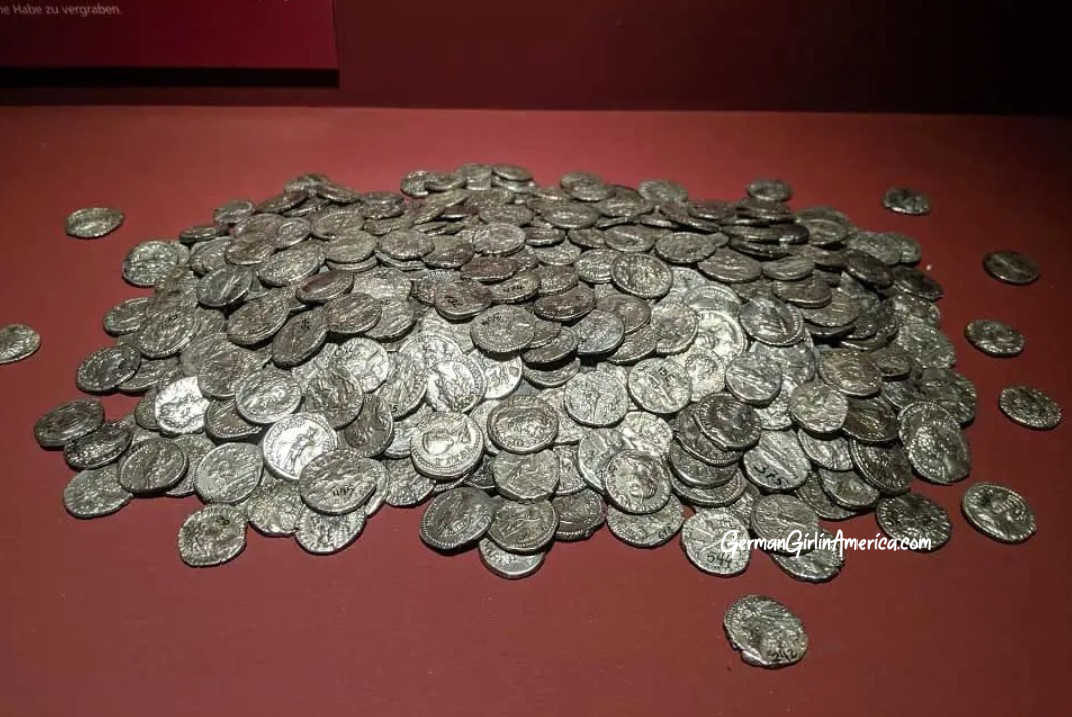
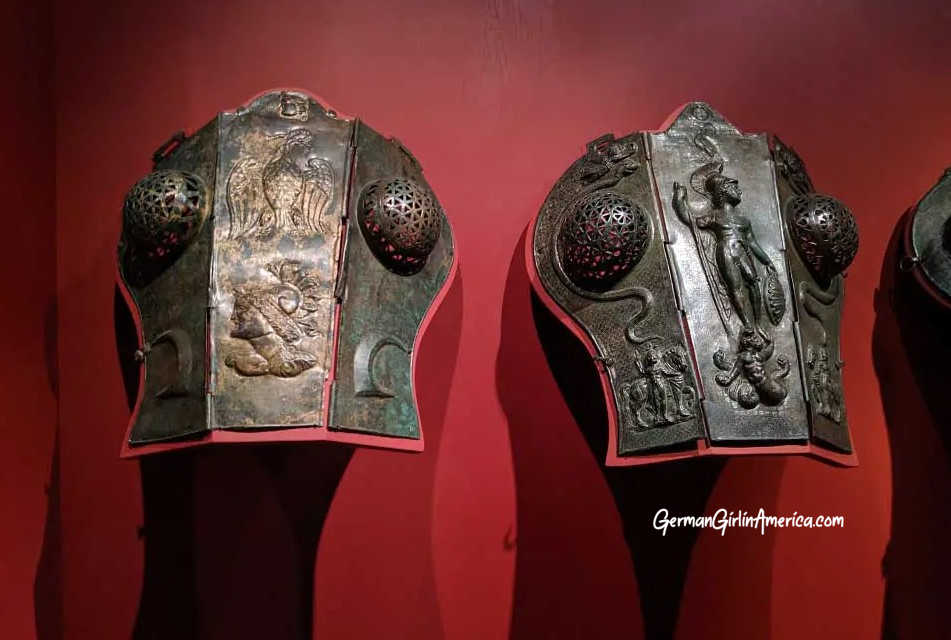
People have been unearthing treasure in Straubing for a LONG time. The Gäubodenmuseum got its start in 1845, when someone had the idea of displaying outdated weapons from the city armory. By 1898, the city formed a Historical Association, and the museum collection doubled. Everyone in town must have donated the items from their own collections. Then, in 1950, archaeologists made a remarkable find: the largest deposit of Roman parade armor ever found in Germany. The museum grew, and today it has several distinct departments, including “Prehistory, “Early Bavaria in Straubing”, “Straubing – Under Elector and King”, “Sacred Art”, and a Roman department including a Treasure Trove and an exhibition unit camp village, religion, and burial artifacts.
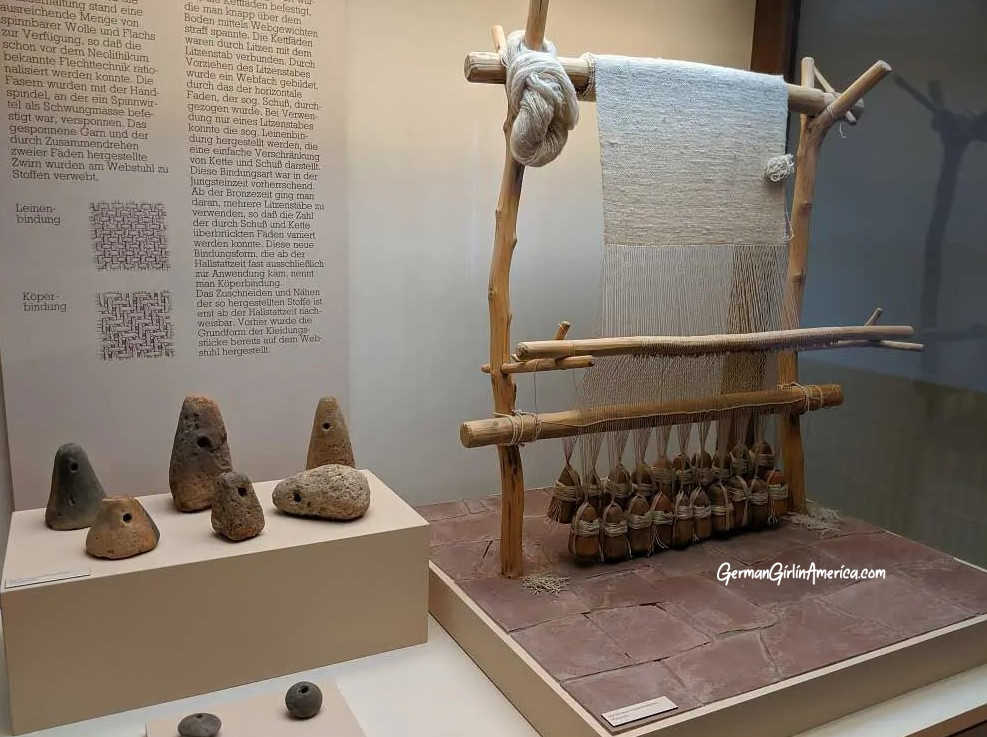
An early loom using stones as weights
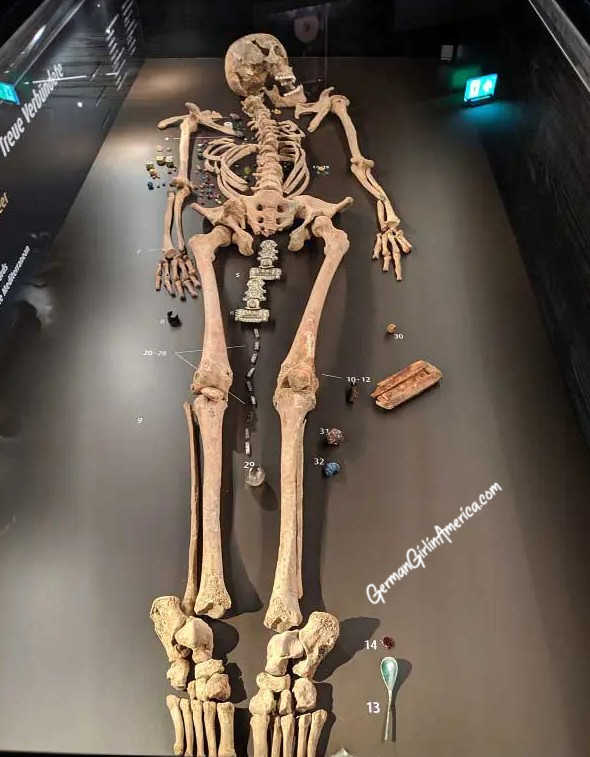
My Favorite section was the room that described burial customs from each group. Including what they were buried with, or what was found in the site. There were tribal burials, Romans, and even pieces from the Middle Ages. The displays were set into lit cases that were low enough for someone in a wheelchair to look in. The cables you see are part of the audio system that explains each exhibit (all in different voices!)
I admit, I was captivated by the Roman section of the Gäubodenmuseum. There were so many pieces of armor normally just worn for “show”. Parade and formal wear, for men and horses.
Then into Bavarian Times.
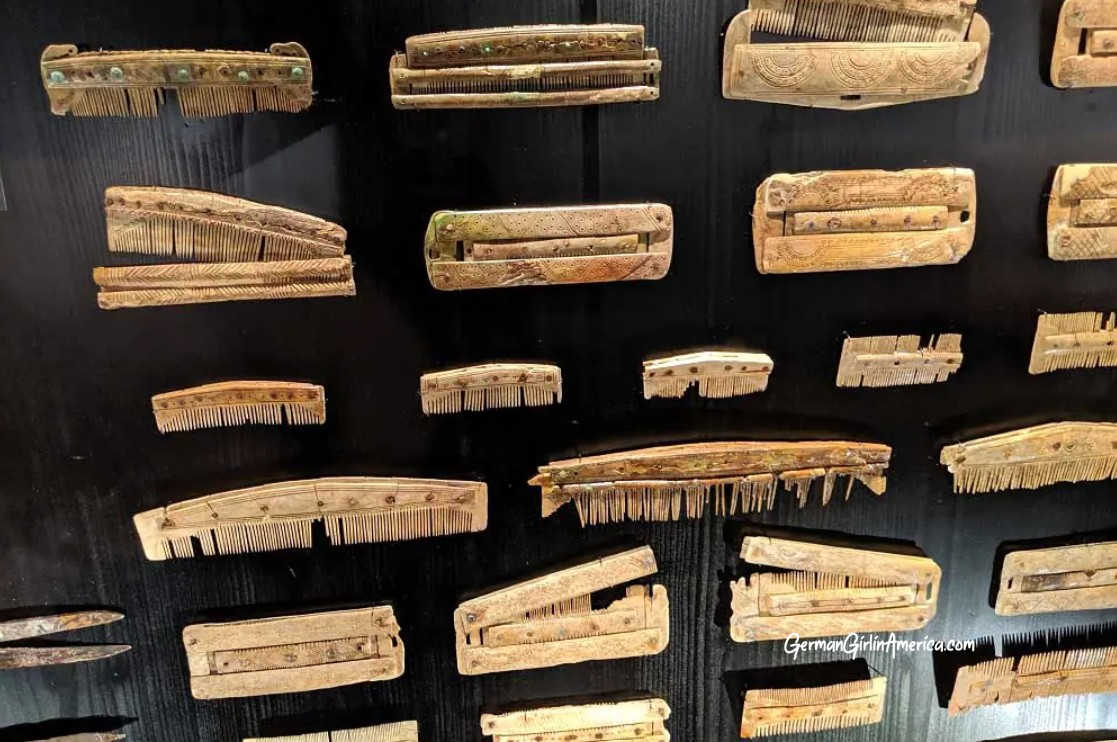
It’s amazing just how much was preserved. Jewelry and religious artifacts filled rooms. Wall displays had hundreds of pieces. It would be overwhelming, but the displays kept things organized and easy to take in.
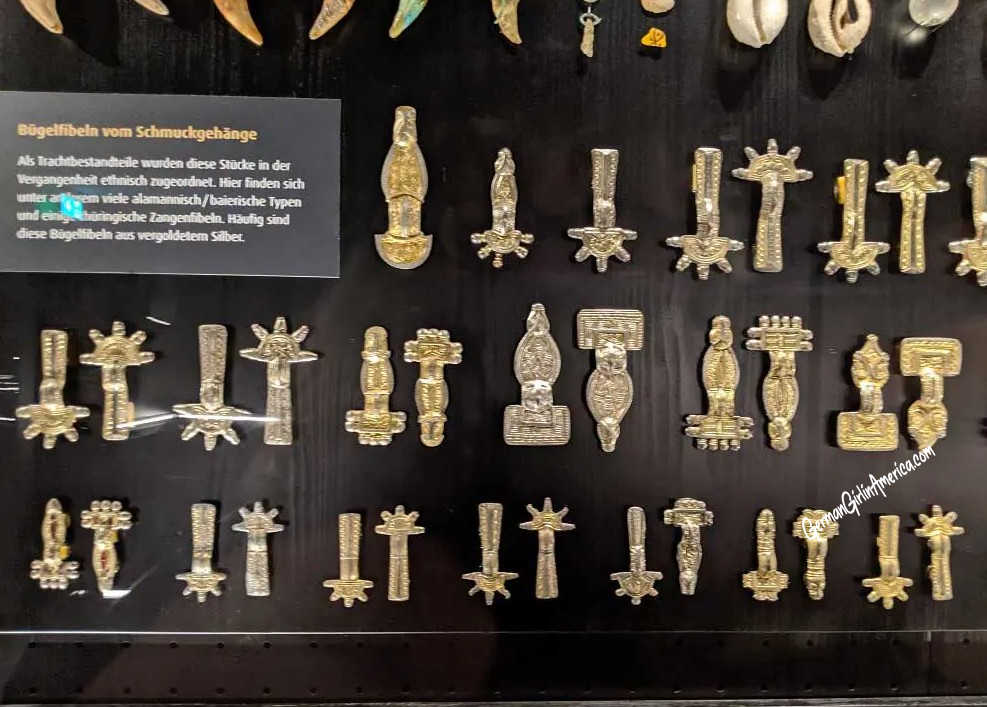
Bavarian Brooches or Clasps
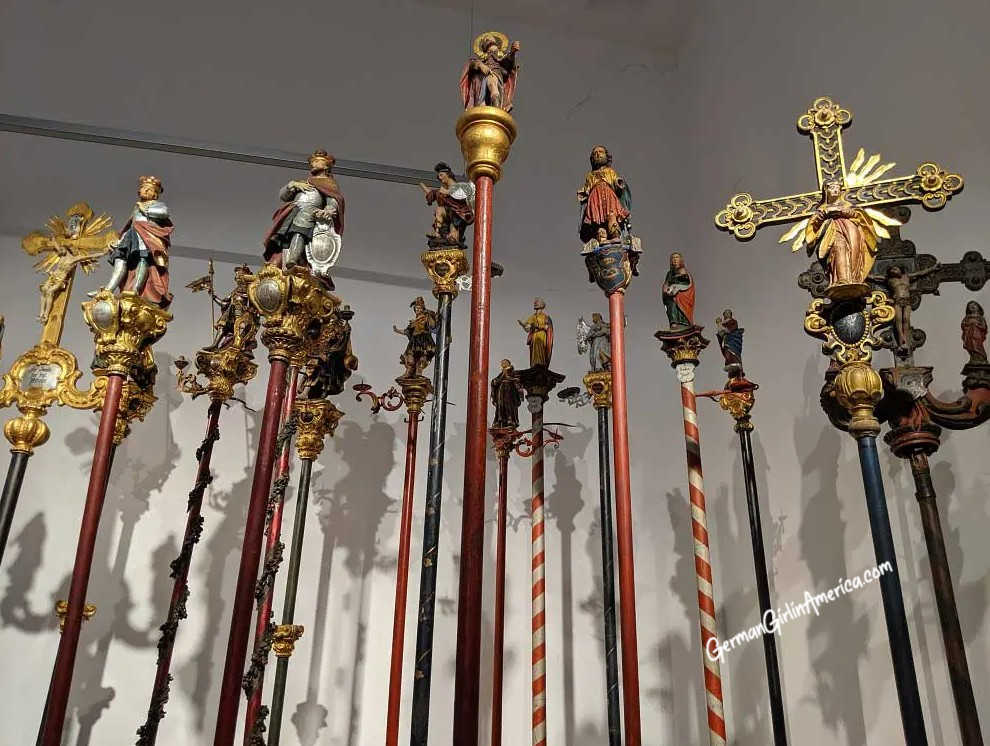
Procession Staffs
The city of Straubing itself is well worth a visit. The beautiful Altstadt, centered on Theresienplatz and Ludwigsplatz, with the Stadtturm (lookout tower) at its center, is lined with shops and restaurants. You’ll find St Urseline’s, an Asam church, at one end. And die Kirche Aufnahme Mariens in den Himmel on the other end. Both are stunning to look at. Spend some time wandering around, but be sure to give yourself time to visit and enjoy the Gäubodenmuseum. It’s your chance to see 7000 years of the history of Bavaria all under one roof.
Plan your trip here– Gäubodenmuseum Visitor Informtion
